What Are Steel Shot and Steel Grit?
A practical look at the shapes, working mechanisms, typical uses, and selection differences between steel shot and steel grit.
Review the information on this page and confirm product selection against the operating context.
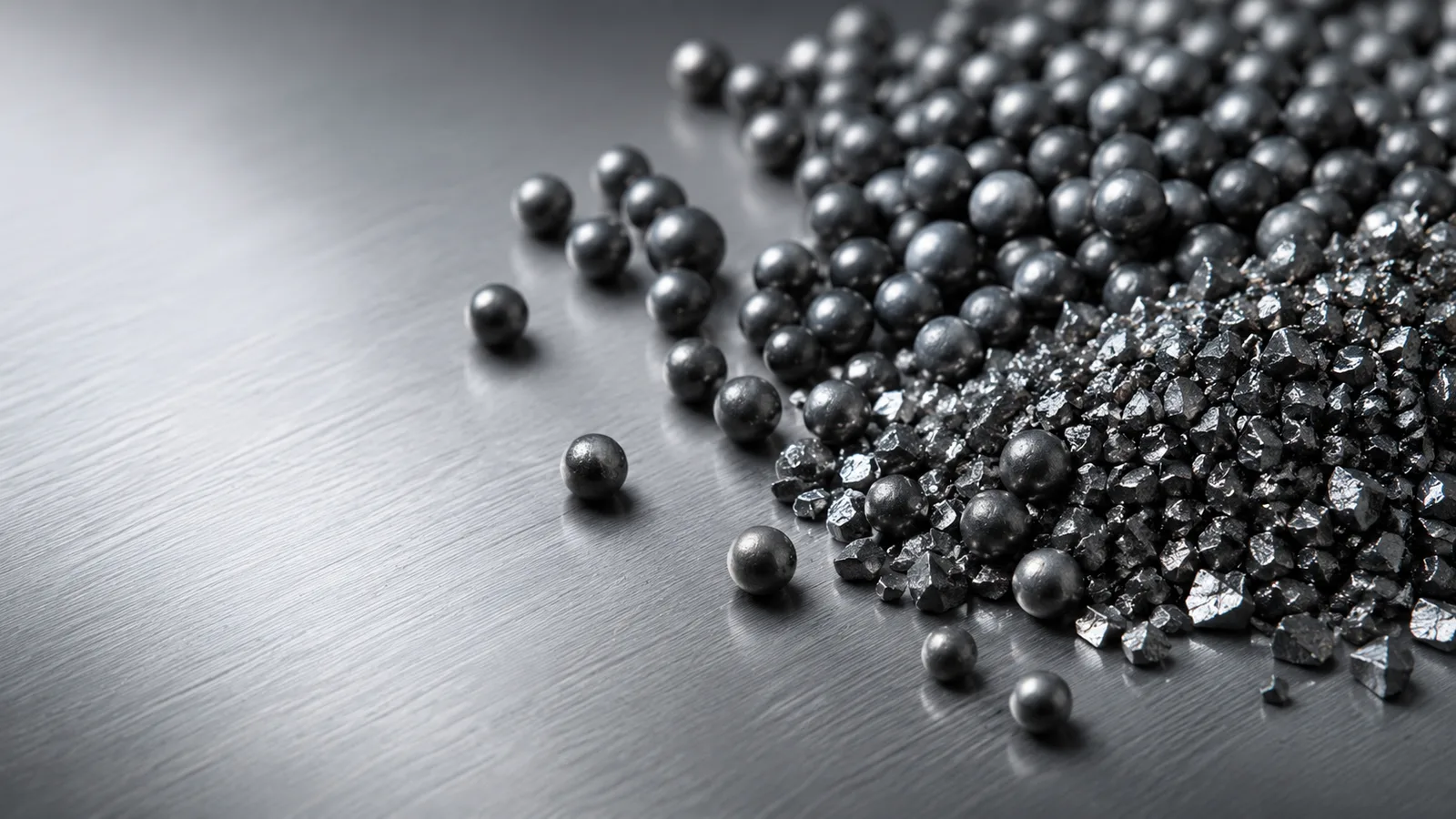
Steel shot and steel grit are both reusable steel abrasives. They show up often in shot blasting, abrasive blasting, and steel surface preparation. Both start from steel and go through melting, particle formation, heat treatment, and sizing, but the final particle shape is different—and that changes how each abrasive works. ISO 11124-3 covers high-carbon cast-steel shot and grit for blast-cleaning; SAE J444 sets the common size designations (International Organization for Standardization [ISO], 2018; SAE International, 2023).
Steel shot: impact and coverage
Steel shot is generally round. A blast wheel or compressed air accelerates the particles to high speed, and each particle hits the workpiece with impact energy. That impact removes foundry sand, mill scale, and ordinary surface contamination from castings, forgings, heat-treated parts, and other mass-produced components.
Particle size matters. Larger shot carries more energy per particle, while smaller shot usually covers more surface under the same blasting conditions. Hardness, roundness, internal soundness, and the condition of the operating mix also affect breakage, dust levels, and process stability.
Steel grit: cutting action and surface profile
Steel grit has angular, irregular edges. When those edges hit the surface at speed, they cut and scrape more aggressively than round shot. That makes steel grit a common choice for removing rust, scale, and old coatings, or for producing a surface profile before painting or applying a protective coating.
Steel grit is not just a “stronger” form of steel shot. The two solve different problems: shot gives impact and uniform coverage, while grit gives cutting action and profile generation.
Why the distinction matters
In blast systems that recover and reuse abrasive, both shot and grit gradually wear and fracture. This creates an operating mix with a range of particle sizes. A stable operating mix helps balance impact energy, coverage, and cleaning consistency. Shot and grit are sometimes blended when a job needs both coverage and cutting action.
The final result depends on more than the choice between steel shot and steel grit. Particle size, hardness, shape, blast speed, equipment type, workpiece material, required cleanliness, and required surface profile all play a part.
YUXIN supplies cast steel shot from S70 to S1110 and cast steel grit in GP, GL, and GH hardness classes from G12 to G120. The most suitable grade depends on the workpiece material, equipment, surface condition, and required finish.
Reference List
International Organization for Standardization. (2018). Preparation of steel substrates before application of paints and related products—Specifications for metallic blast-cleaning abrasives—Part 3: High-carbon cast-steel shot and grit (ISO Standard No. 11124-3:2018). https://www.iso.org/standard/66706.html
SAE International. (2023). Cast shot and grit size specifications for cleaning and peening (SAE Standard J444_202306). https://www.sae.org/standards/j444_202306-cast-shot-grit-size-specifications-cleaning-peening