Applications of Steel Shot and Steel Grit in Shipbuilding
How steel shot and steel grit are used for ship plate, hull structures, maintenance, and surface preparation before protective coating.
Review the information on this page and confirm product selection against the operating context.
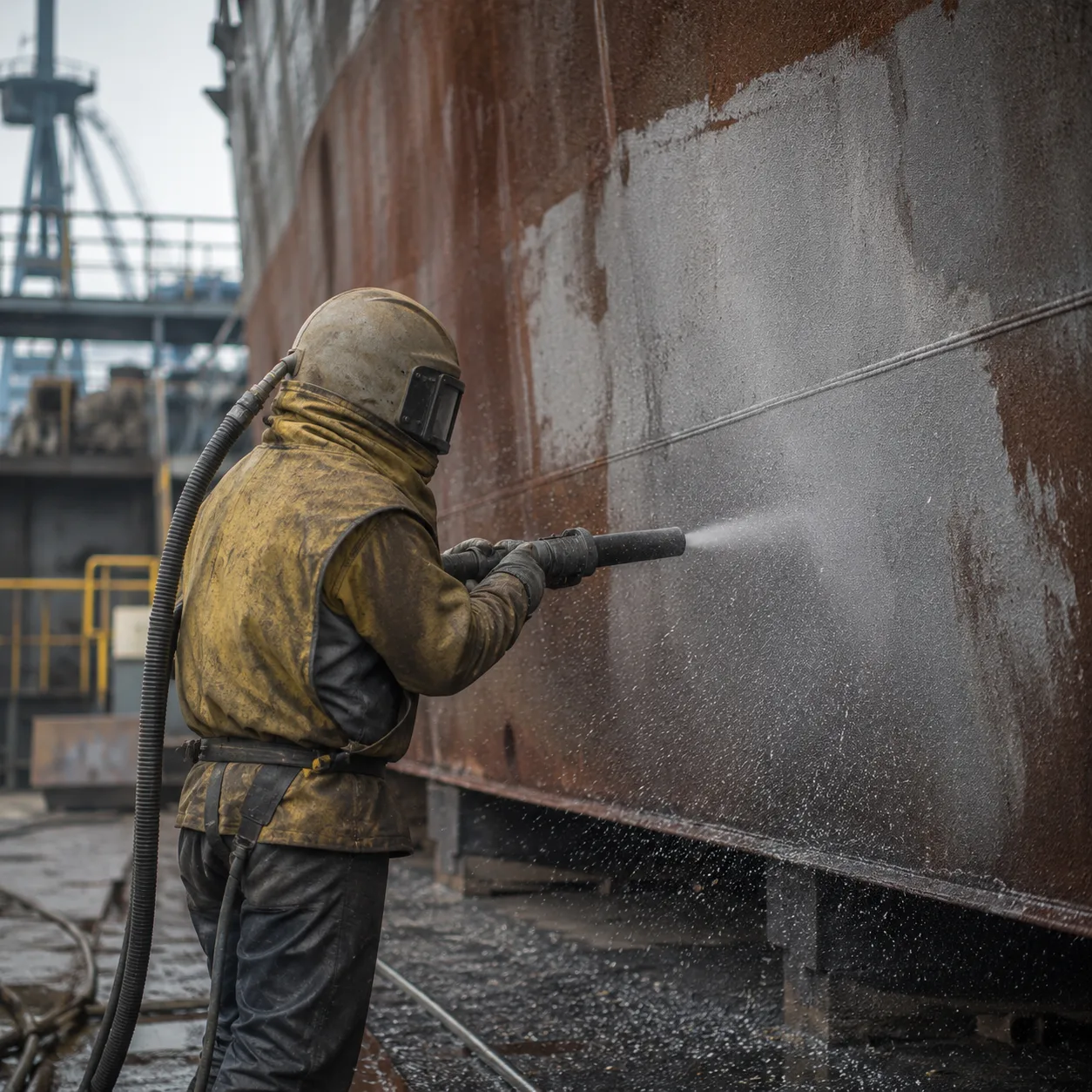
Ships spend their working life in humid, saline, and seawater environments. Steel plate and structural components therefore need careful surface preparation before any protective coating goes on. In a shipyard, blast cleaning is not just about making steel look clean. The process has to remove rust, mill scale, and old coatings while leaving a surface that matches the coating system being used. ISO 8501-1 sets out a way to visually assess steel surface cleanliness, and ISO 8503-1 deals with the profile of blast-cleaned steel surfaces (International Organization for Standardization [ISO], 2007, 2012).
Steel Grit for Cutting Action and Surface Profile
Cast steel grit has angular edges. At high speed, those edges cut and scrape the steel surface far more aggressively than round shot. That makes grit a common choice on ship plate, hull blocks, deck structures, and other carbon-steel parts where rust, mill scale, or tightly bonded coatings have to come off before painting.
Grit size and hardness affect the result. Coarser grains carry more impact per particle and tend to leave a deeper profile, while finer grains cover the surface more densely. Higher hardness usually helps the angular edges stay sharp longer, but actual wear, dust, and consumption depend on blast energy, how the abrasive is recovered, and the condition of the workpiece.
Steel Shot for Impact and Consistent Coverage
Cast steel shot is near-spherical and works mainly through impact. It suits general cleaning, mill-scale removal, and recyclable wheel-blast lines where consistent coverage matters. In some shipyard processes, shot and grit are used together so the round particles provide even coverage while the angular particles do the cutting.
Steel shot and steel grit are not direct substitutes. Shot leans toward uniform impact and coverage; grit leans toward cutting and surface profile. Choosing the right abrasive means matching it to the initial steel condition, coating system, required cleanliness, required profile, and blasting equipment. ISO 8504-2 describes abrasive blast-cleaning as a method for preparing steel before coating and stresses that the process should be selected according to the surface and the coating requirements that follow (ISO, 2019).
YUXIN supplies cast steel shot from S70 to S1110 and cast steel grit in GP, GL, and GH types from G12 to G120. These cover a range of surface-treatment conditions in shipbuilding and ship maintenance.
Reference List
International Organization for Standardization. (2007). Preparation of steel substrates before application of paints and related products—Visual assessment of surface cleanliness—Part 1: Rust grades and preparation grades of uncoated steel substrates and of steel substrates after overall removal of previous coatings (ISO Standard No. 8501-1:2007). https://www.iso.org/standard/43426.html
International Organization for Standardization. (2012). Preparation of steel substrates before application of paints and related products—Surface roughness characteristics of blast-cleaned steel substrates—Part 1: Specifications and definitions for ISO surface profile comparators for the assessment of abrasive blast-cleaned surfaces (ISO Standard No. 8503-1:2012). https://www.iso.org/standard/51979.html
International Organization for Standardization. (2019). Preparation of steel substrates before application of paints and related products—Surface preparation methods—Part 2: Abrasive blast-cleaning (ISO Standard No. 8504-2:2019). https://www.iso.org/standard/72939.html