Metal Abrasives for Foundry
How cast steel shot and steel grit are used for foundry desanding, oxide-scale removal, casting cleanup, machining and inspection preparation, and coating preparation.
Review the information on this page and confirm product selection against the operating context.
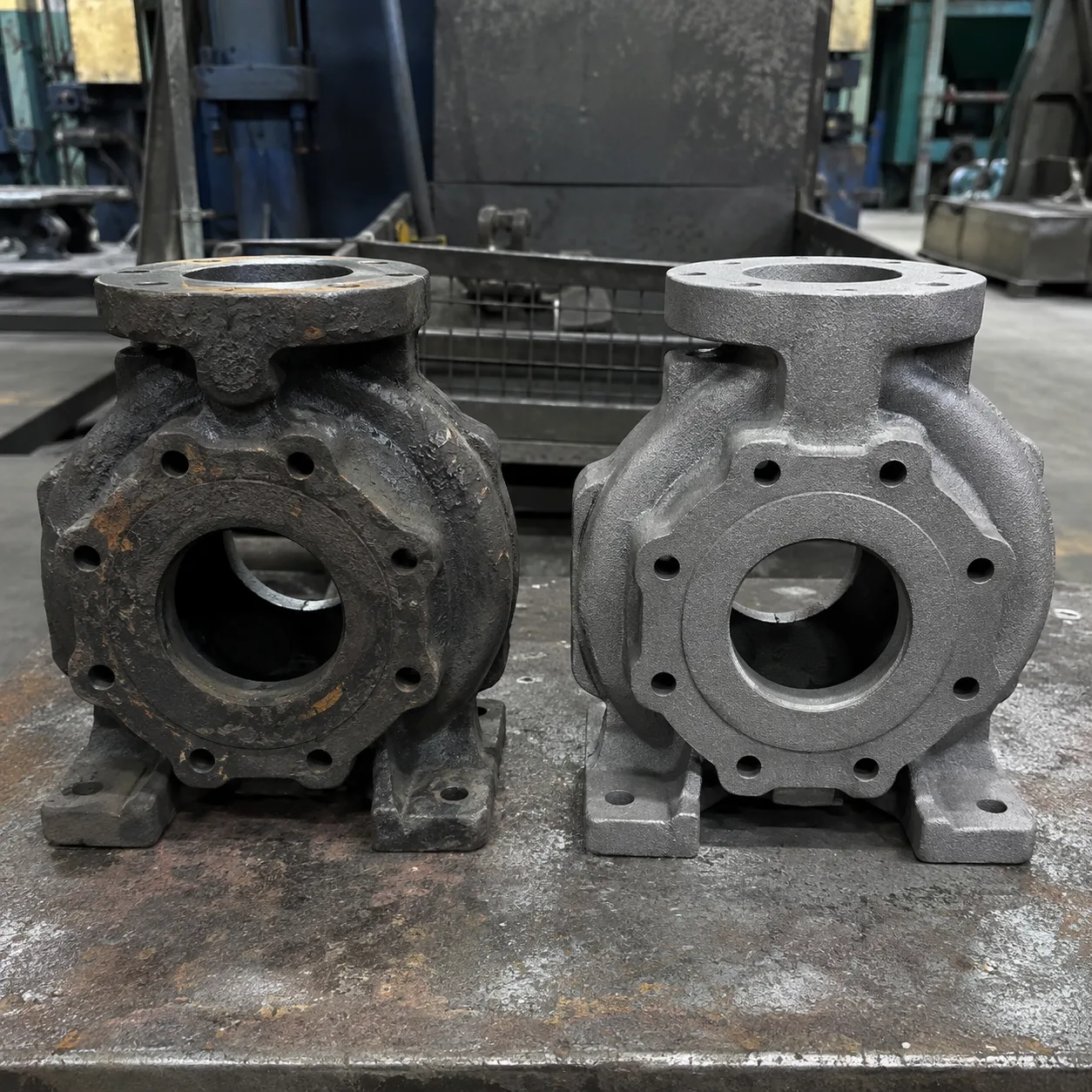
After shakeout and cooling, steel and iron castings often still carry moulding sand, burned-on sand, oxide scale, and other process residue. These contaminants cause problems in inspection, machining, welding, coating, and assembly, so surface cleaning is a standard part of foundry finishing. ASM International includes shot blasting, core removal, degating, and flash removal among the main casting-cleaning operations (Nath, 2023).
For ferrous foundries, cast steel shot is usually the primary reusable abrasive for desanding and general casting cleanup. Cast steel grit plays a more specialized role because its angular particles cut more aggressively. ISO 11124-3 covers high-carbon cast-steel shot and grit for blast cleaning and notes that both are especially suitable when abrasive recovery and reuse are available (International Organization for Standardization [ISO], 2018).
Steel Shot for Desanding and General Casting Cleaning
Near-spherical steel shot is thrown against the casting surface by blast wheels or compressed air. The repeated impacts remove residual moulding sand, surface oxides, and general process contamination from steel castings, gray iron, ductile iron, and other ferrous cast parts.
Typical workpieces include valve bodies, pump housings, flanges, pipe fittings, wheels, hubs, gearbox housings, automotive castings, and heavy-equipment castings. SAE J827 defines chemical-composition and physical requirements for high-carbon cast-steel shot used in blast cleaning or shot peening, while SAE J444 gives the standard S-size designation system (SAE International, 2019a, 2023).
Cleaning isn’t only about appearance. Sand can accelerate tool wear in machining, and scale or surface contamination makes it harder to see the true casting surface. A properly cleaned casting is easier to inspect and better prepared for machining, welding, or coating.
When Steel Grit Is Useful
Steel grit isn’t normally the first choice for routine foundry desanding. Its angular shape produces a stronger cutting and scraping action than spherical steel shot. It becomes useful when a casting has tightly bonded oxide scale, heat-treatment scale, storage rust, or needs a more pronounced surface profile before coating.
SAE J1993 describes high-carbon cast-steel grit for blast-cleaning and etching operations (SAE International, 2019b). Grit is the right option when impact cleaning alone can’t achieve the required surface condition efficiently.
On thin-wall castings, sharp edges, or dimension-sensitive areas, too much grit aggressiveness can cause unwanted surface damage. Steel shot is therefore the usual starting point for general casting cleaning.
Shot Size, Surface Condition, and Cleaning Result
Shot size changes the balance between impact energy and coverage. Larger shot has more mass per particle and generally hits harder. Smaller shot provides more particles per unit mass and denser coverage.
In foundry practice:
Coarser shot suits heavy castings and strongly adhered sand or scale.
Medium shot gives a practical balance for general casting cleaning.
Finer shot provides denser coverage and reaches smaller surface details better.
SAE J444 standardizes cast shot and grit size designations, which makes size specs easier to communicate between foundries, equipment manufacturers, and abrasive suppliers (SAE International, 2023).
The final surface isn’t set by shot size alone. Research on cast surfaces shows that roughness after blasting depends on both the original casting surface and the blasting process itself (Nwaogu et al., 2013). Research on ductile iron also shows that shot blasting can change surface roughness and residual stresses, so cleaning intensity and surface integrity have to be considered together (Yamabe & Kobayashi, 2006).
Operating Mix and Abrasive Recovery
A foundry blast machine never contains only new abrasive. During repeated circulation, steel shot wears and breaks into smaller particles, creating an operating mix of different sizes. A stable mix helps balance impact energy and surface coverage.
Foundries also face a specific recycling problem: moulding sand removed from castings enters the abrasive recovery system. If sand, fines, and broken abrasive aren’t separated effectively, they can change blasting performance and increase equipment wear.
The abrasive itself can’t make up for poor blast coverage. Tumble-blast machines, spinner-hanger systems, table machines, and continuous lines handle castings differently. Deep recesses, ribs, and complex geometries need the right workpiece movement, wheel position, abrasive flow, and cycle time to be exposed properly to the blast stream.
Steel Shot vs. Steel Grit in Foundry Applications
Foundry Requirement | Steel Shot | Steel Grit |
|---|---|---|
Residual sand removal | Primary choice | Conditional |
General casting cleanup | Primary choice | Conditional |
Oxide-scale removal | Suitable | More aggressive option |
Heat-treatment scale | Suitable | Useful for strongly adhered scale |
Preparation before machining | Common | Use with surface-control requirements |
Preparation before inspection | Common | Conditional |
Coating preparation | Suitable where profile is adequate |
Material Compatibility
Carbon steel shot and grit are mainly suited to ferrous castings. They shouldn’t be used automatically on aluminum, stainless steel, or other contamination-sensitive castings because transferred ferrous material may conflict with corrosion resistance, appearance, or cleanliness requirements.
For those materials, abrasive compatibility, equipment cleanliness, recovery-system segregation, and customer specifications need separate evaluation.
The Practical Foundry Selection Logic
For foundry desanding and routine casting cleaning, cast steel shot is normally the primary product because it gives broad, repeatable impact coverage. Steel grit is the more aggressive option when firmly adhered scale, rust, or a defined coating profile must be addressed.
The final result depends on the whole process: shot size, hardness, operating mix, blast velocity, machine geometry, cycle time, casting shape, and initial surface condition all matter.
YUXIN supplies high-carbon cast steel shot from S70 to S1110 and cast steel grit in GP, GL, and GH hardness classes from G12 to G120.
Reference List
International Organization for Standardization. (2018). Preparation of steel substrates before application of paints and related products—Specifications for metallic blast-cleaning abrasives—Part 3: High-carbon cast-steel shot and grit (ISO Standard No. 11124-3:2018). https://www.iso.org/standard/66706.html
Nath, J. (2023). Casting cleaning operations. In Casting equipment engineering guide (pp. 95–114). ASM International. https://doi.org/10.31399/asm.tb.ceeg.t59370095
Nwaogu, U. C., Tiedje, N. S., & Hansen, H. N. (2013). A non-contact 3D method to characterize the surface roughness of castings. Journal of Materials Processing Technology, 213(1), 59–68. https://doi.org/10.1016/j.jmatprotec.2012.08.008
SAE International. (2019a). High-carbon cast-steel shot (SAE Standard J827_201910). https://doi.org/10.4271/J827_201910
SAE International. (2019b). High-carbon cast-steel grit (SAE Standard J1993_201902). https://doi.org/10.4271/J1993_201902
SAE International. (2023). Cast shot and grit size specifications for cleaning and peening (SAE Standard J444_202306). https://doi.org/10.4271/J444_202306
Yamabe, J., & Kobayashi, M. (2006). Effects of surface roughness and residual stress on fatigue strength of shot blasted ductile cast irons with casting surfaces. Journal of the Society of Materials Science, Japan, 55(3), 301–308. https://doi.org/10.2472/jsms.55.301